Ever heard your child come home from school talking not about homework, but about a mini garden they designed with their friends? That is one example of learning through projects.
In short, PjBL is a way of learning where students understand the material by working on real projects, rather than just listening to explanations and then answering questions. However, not every project assignment automatically counts as PjBL. Whether you are a parent or a teacher, let's start with its definition.
What Is Project Based Learning (PjBL)?
PjBL stands for Project Based Learning. In this model, students learn by investigating a real problem or question, then turning what they have learned into a product or a presentation. The process is not short: according to PBLWorks, a good project lasts more than a few days, because students need to ask questions, look for answers, and then ask even deeper questions.
In the classroom, PjBL usually looks like this:
- Students work on a project over a period of a few days to a few weeks.
- They work in teams and divide roles among themselves.
- The teacher acts as a guide, not the only source of answers.
- The results are shown to other people, not just handed in to the teacher.
You may also come across the abbreviation PBL. It can mean Project Based Learning, but it can also mean Problem Based Learning, and the difference is covered further below. To build a stronger understanding, here is how two international references view PjBL.
PjBL According to Experts
- Larmer and Mergendoller (2015). Through the Gold Standard PBL framework, they place a problem to solve or a question to answer at the core of a project, aligned with the learning goals and carried out through sustained inquiry.
- Blumenfeld and colleagues. Their view, referenced by Edutopia, emphasizes teaching that involves students in investigation.
Both stress the same thing: students learn by investigating something real.
Characteristics of Project Based Learning
Not every classroom project deserves to be called PjBL. PBLWorks defines 7 essential project design elements that set a high-quality project apart from a mere extra assignment. In simple terms:
- A challenging problem or question. The project starts from a question that cannot be answered with a single search, for example “How can our school reduce waste?”
- Sustained inquiry. Students keep asking questions, looking for sources, trying things out, and then asking deeper questions, rather than just reading one article.
- Authenticity. The project is connected to the real world, whether through problems that real people face, tools that professionals use, or a real impact on others.
- Student voice and choice. Students help decide some things, such as their roles in the team, their learning resources, or the form of the final product.
- Reflection. Students and teachers pause to assess what has been learned and how it was learned.
- Critique and revision. Students learn to give and receive feedback, then improve their work.
- Public product. The work is shown to an audience beyond the teacher, such as another class, parents, or the community.
The more of these elements are present, the stronger the project is as PjBL. PBLWorks itself notes that not all elements will be strong in a teacher's first project. They grow along with the experience of teachers and students.
Objectives of Project Based Learning
According to the PBLWorks framework, projects are designed so that students achieve two things at once: understanding the subject matter in depth, and mastering the skills they need in school, college, and the workplace. The two cannot be separated, because skills can only be developed through real subject matter.
The general objectives of PjBL:
- Understanding concepts in depth and being able to apply them to real problems, not just remembering them for exams.
- Training critical thinking and problem solving.
- Training teamwork.
- Training communication, including presenting ideas.
- Nurturing creativity and the ability to manage a project from start to finish.
PBLWorks recommends that each project target one or two specific skills so that the focus does not spread too thin. From the perspective of schools and teachers, the ultimate goal is students who are independent learners: they know how to ask questions, find answers, and see their work through to the end.
Project Based Learning Syntax: 6 Steps for Classroom Implementation
Syntax is the sequence of working steps in a learning model. The number of steps can differ between sources, but the most commonly used flow consists of six steps, as described in Edutopia's guide on how project based learning works. Below is an explanation of each step, along with the roles of the teacher and students.
Step 1: Start with the Essential Question
Everything starts with a driving question. A good question is close to students' lives and makes them curious, for example “How can we make our school canteen healthier?”
- Teacher: formulates a question that fits the learning goals and the students' age.
- Students: ask follow-up questions and start guessing the direction of the answer.
Step 2: Design a Plan for the Project
Teachers and students draw up a plan: what will be made, who does what, and what is needed. Involving students from this stage makes them feel ownership of the project.
- Teacher: makes sure the plan stays connected to the subject matter.
- Students: decide on role distribution, materials, and the form of the final product.
Step 3: Create a Schedule
The project is broken down into small stages with clear deadlines. Leave some flexible room, because projects rarely go exactly as planned.
- Teacher: helps students manage their time.
- Students: build a timeline and agree on deadlines with their team.
Step 4: Monitor the Students and the Progress of the Project
While the project is running, the teacher walks around, asks questions, and gives feedback without taking over the students' work. Rubrics for teams and projects help monitor the process, not just the final result.
- Teacher: guides and monitors each team member's contribution.
- Students: record their progress and adjust the plan when problems arise.
Step 5: Assess the Outcome
Students present the results of the project through a product or a presentation. This stage is also an assessment moment: the teacher looks at how well students have mastered and applied the material, while students receive feedback.
- Teacher: assesses the product and the process using a rubric.
- Students: present their results and receive feedback from the teacher and their peers.
Step 6: Evaluate the Experience
The project ends with reflection: what worked, what was difficult, and what will be done differently in the next project. Reflection can take the form of a short journal or a group discussion.
- Teacher: uses students' input to improve the next project.
- Students: reflect on what they learned and how they worked.
Summary of the 6 PjBL Steps in a Table
To make it easier, here is a summary of the six steps.
Step | Teacher's role | Students' role | Outcome
1. Start with the essential question | Formulates the driving question | Asks follow-up questions | An agreed project question
2. Design a plan for the project | Keeps the plan connected to the material | Decides on roles, materials, and the final product | Project plan
3. Create a schedule | Helps manage time | Builds a timeline | Schedule and deadlines
4. Monitor the project | Guides and gives feedback | Records progress and adjusts the plan | Project stays on track
5. Assess the outcome | Assesses with a rubric | Presents and receives feedback | Product and assessment
6. Evaluate the experience | Takes in feedback for the next project | Reflects | Lessons for the next project
Note: these six steps are described in Edutopia's guide. PBLWorks uses a different framework, namely the project design elements covered in the characteristics section, so the two complement each other.
Examples of Project Based Learning in Schools
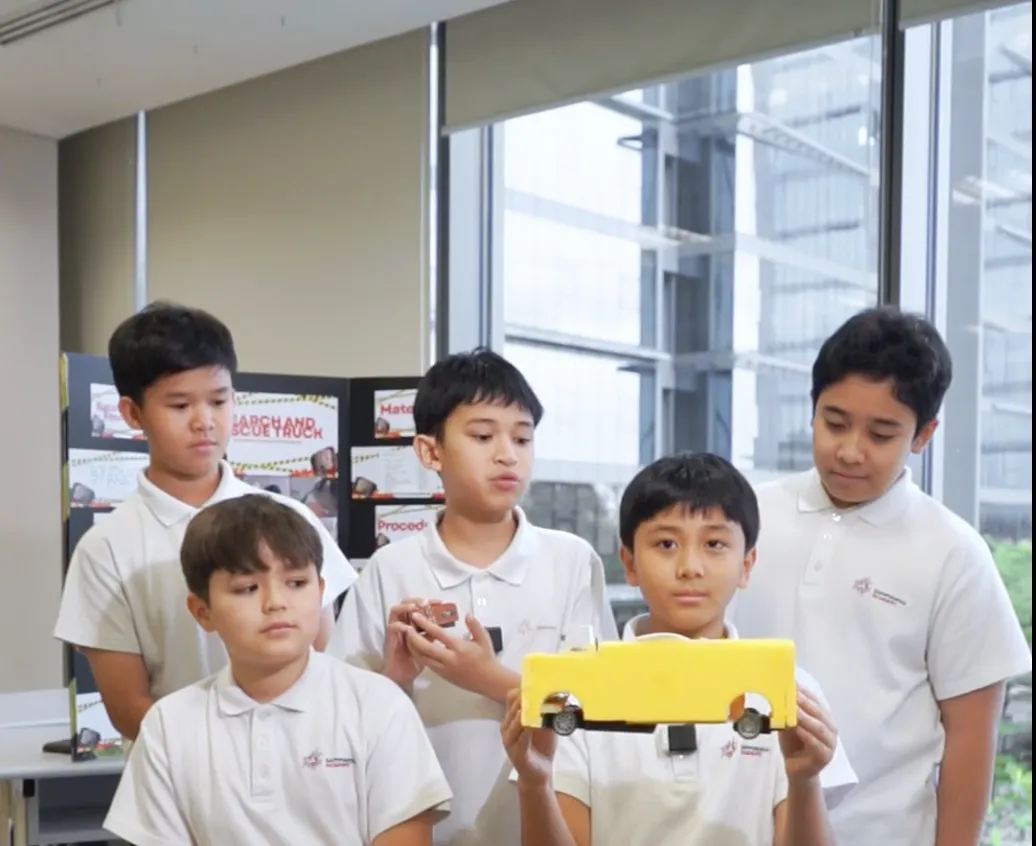
PjBL Example for Early Years and Elementary School (SD): A Mini School Garden
This project suits children who are still learning through real objects.
- Driving question: “How can we grow vegetables that we can eat together at school?”
- Duration: about 3 to 4 weeks.
- Subjects: science (plants), basic math (measuring and counting), language (writing growth notes).
- Final product: a mini garden and a short presentation to another class.
- Assessment: observation notes, a simple rubric for teamwork, and the presentation.
PjBL Example for Middle School (SMP): Improving the School Recycling System
Middle school students can already process data and build arguments, so the project can be more analytical.
- Driving question: “What can we change so that the waste sorting and recycling system at our school works better?”
- Duration: about 4 to 6 weeks.
- Subjects: natural science (types of waste and their impact), math (processing waste data), language (writing recommendations).
- Final product: a data report and an improvement proposal presented to the school leadership.
- Assessment: a rubric for data quality, clarity of argument, and teamwork.
PjBL Example for High School (SMA): A Business Plan for an Eco-Friendly Product
At this level, students can take on the role of entrepreneurs who must convince a panel of evaluators.
- Driving question: “What product could we make to help reduce plastic waste, and is it viable to sell?”
- Duration: about 6 to 8 weeks.
- Subjects: economics or entrepreneurship, chemistry or physics (choosing materials), art and design (packaging), language (presentation).
- Final product: a product prototype and a business plan presented to a panel of evaluators.
- Assessment: a rubric for the viability of the idea, prototype quality, presentation, and the panel's feedback.
Notice that all three share the same pattern: a challenging question, teamwork, results shown to other people, and assessment that looks at both the process and the result.
Benefits of Project Based Learning for Students, Teachers, and Parents
The benefits of PjBL are not felt by students alone. Teachers and parents also feel the impact, in different forms.
Benefits for Students
- Trained in critical thinking and problem solving.
- Used to working together and communicating.
- More confident in presenting ideas in front of others.
- Understand concepts more deeply because they use them directly in projects.
Some research also supports its academic benefits. In a study supported by Lucas Education Research, second graders in high-poverty schools who learned through projects gained the equivalent of 5 to 6 months of additional learning in social studies and about 2 months in informational reading. In another study, third graders scored 8 percentage points higher on a state science test. However, both studies were conducted in the United States, so the results may not be exactly the same in Indonesia.
Benefits for Teachers
- Classes come alive because students are actively working, not just listening.
- Teachers can see students' thinking process, not just their final answers.
- While guiding teams, teachers have room to give more personal feedback.
Benefits for Parents
- Seeing real learning results. PBLWorks gives the example of schools that turn their open house into a student project exhibition, so families can see directly what their children are capable of making.
- Children get used to explaining their ideas and reasoning, because project results must be presented.
- Children gain experience in finishing something from start to end, which helps build independence.
Advantages and Disadvantages of Project Based Learning
Like any other method, PjBL has strengths and points to watch out for. Looking at both helps you judge whether the method is truly being implemented well.
Advantages of Project Based Learning
- Learning is more contextual, because the material is used to solve real problems.
- Students are more active and engaged.
- 21st-century skills are trained alongside mastery of the material.
- A single project can connect several subjects.
- Learning results become visible through products or presentations.
Disadvantages and Challenges of Project Based Learning
- It takes time and careful preparation from teachers.
- Assessment is more complex because both the process and the result must be assessed.
- Team members' contributions can be uneven if not monitored.
- The quality of the results depends heavily on the project design.
The research results are also not uniform. Duke and Halvorsen's study in second grade found improvements in social studies and informational reading, but not in writing skills or student motivation. PBLWorks itself acknowledges that research on PBL has limitations. In other words, PjBL is not an automatic shortcut. The quality of its implementation is what makes the difference.
The Difference Between Project Based Learning and Problem Based Learning
Both are abbreviated as PBL, so they are easily mixed up. The differences are more of tendencies than hard rules, and in practice the two can overlap.
In short, PjBL centers on creating a product or presentation through a project, while problem based learning centers on solving a problem that has been set. Savery (2006) describes problem based learning as a learner-centered approach in which students research, connect theory with practice, and then apply their knowledge to find a solution to a particular problem.
Aspect | Project Based Learning | Problem Based Learning
Main focus | Producing a product or presentation through a project | Finding a solution to a given problem
Final result | Work that is shown to an audience | A solution or conclusion to the problem
Duration | Tends to be longer | Tends to be shorter
Subject coverage | Often cross-subject | Tends to be a single subject
Teacher's role | A guide who monitors how the project is going | A tutor who guides the learning process and the discussion of results
Context | Often uses real-world tasks | Often uses scenarios or cases
According to Teacher Magazine, which refers to Larmer (2014), PjBL tends to be longer and cross-subject, while problem based learning more often covers a single subject and takes less time.
Want to go deeper? Read the full explanation of problem based learning at Sampoerna Academy.
Project Based Learning and STEAM: Why Are They Often Combined?
STEAM stands for Science, Technology, Engineering, Arts, and Mathematics. This approach invites students to use several of these fields at once to solve a single problem.
This is where PjBL serves as the way to do it. STEAM answers which fields are combined, while PjBL answers how students learn, namely through real projects. Because projects usually involve many fields at once, the two are easy to combine.
A simple STEAM project example: designing a bridge model from recycled materials.
- Science: understanding forces and the strength of materials.
- Technology: using tools or apps to create the design.
- Engineering: building and testing the model.
- Arts: designing an attractive appearance.
- Mathematics: calculating dimensions and loads.
Keep in mind that STEAM and PjBL are not the same thing. A class can use PjBL without any STEAM element, for example through a history or language project.
Frequently Asked Questions About Project Based Learning
Here are short answers to the questions that come up most often, especially from parents and teachers.
What does PjBL stand for, and is it the same as PBL?
PjBL stands for Project Based Learning. The abbreviation PBL can mean either Project Based Learning or Problem Based Learning, so it is safer to use PjBL when referring to project-based learning.
How many steps does project based learning have, 5 or 6?
The number does differ between sources. This article uses the six steps found in Edutopia's guide, and the core flow is similar across sources: asking questions, planning, scheduling, monitoring, assessing, and then reflecting.
What is a simple example of PjBL for elementary school children?
A mini school garden. Children grow vegetables, record their growth, and then present the results to another class. The details are in the examples section above.
Is PjBL suitable for every child?
It suits many children when designed well, because every child can contribute in a different way. Children who still need time to adapt to group work need support from the teacher. Ask the school how teachers monitor and assess each child's contribution.
How are children's projects assessed?
Usually with a rubric that assesses both the process (teamwork, perseverance) and the result (quality of the work), plus presentations, feedback from peers, and self-reflection. PBLWorks also emphasizes critique and revision before the final result is shown.
Does PjBL make children fall behind on the material?
Not automatically. A good project is designed to align with the learning goals. Research shows improvements in some subjects, but not in every aspect, so ask the school how projects are linked to the curriculum.
What is the difference between PjBL and an ordinary project assignment?
An ordinary project assignment is usually done after the material has been taught and is short. In PjBL, the project itself is the vehicle for learning: it starts from a challenging question, involves sustained inquiry, uses reflection and revision, and produces work that is shown to the public.
Sampoerna Academy: An International School That Combines Project Based Learning and STEAM
For parents who want their children to learn through projects and STEAM, Sampoerna Academy combines both. As an international school in Indonesia, Sampoerna Academy brings together an international curriculum and STEAM programs. According to its official website, the STEAM approach there emphasizes collaboration and personalized learning, where groups of students go through meaningful inquiry that aligns with their interests. The spirit is in line with PjBL: learning through real, shared investigation.
What parents should know:
- Levels: from Toddler and Playgroup to Grade 12, plus Online School.
- Locations: L'Avenue (Jakarta), BSD (South Tangerang), Sentul (West Java), Surabaya (Pakuwon Indah and Grand Pakuwon), and Medan (Cipto and Citra).
- STEAM programs: including STEAM Expo and STEAM Competition.
When you visit or have a consultation, you can ask the same questions discussed in this article: how projects are designed, how teachers guide students, and how each child's contribution is assessed. Schedule a consultation or school visit, fill in the Schedule a Consultation form or follow the How to Apply guide on Sampoerna Academy's official website, and the school team will contact you.
.webp)
.webp)
.webp)